RMM & Agents.
Cross-platform agents. ClickHouse telemetry. Zero-trust enrollment.
- →Rust core + TypeScript orchestrator. Signed binaries, auto-updating, remote-revocable.
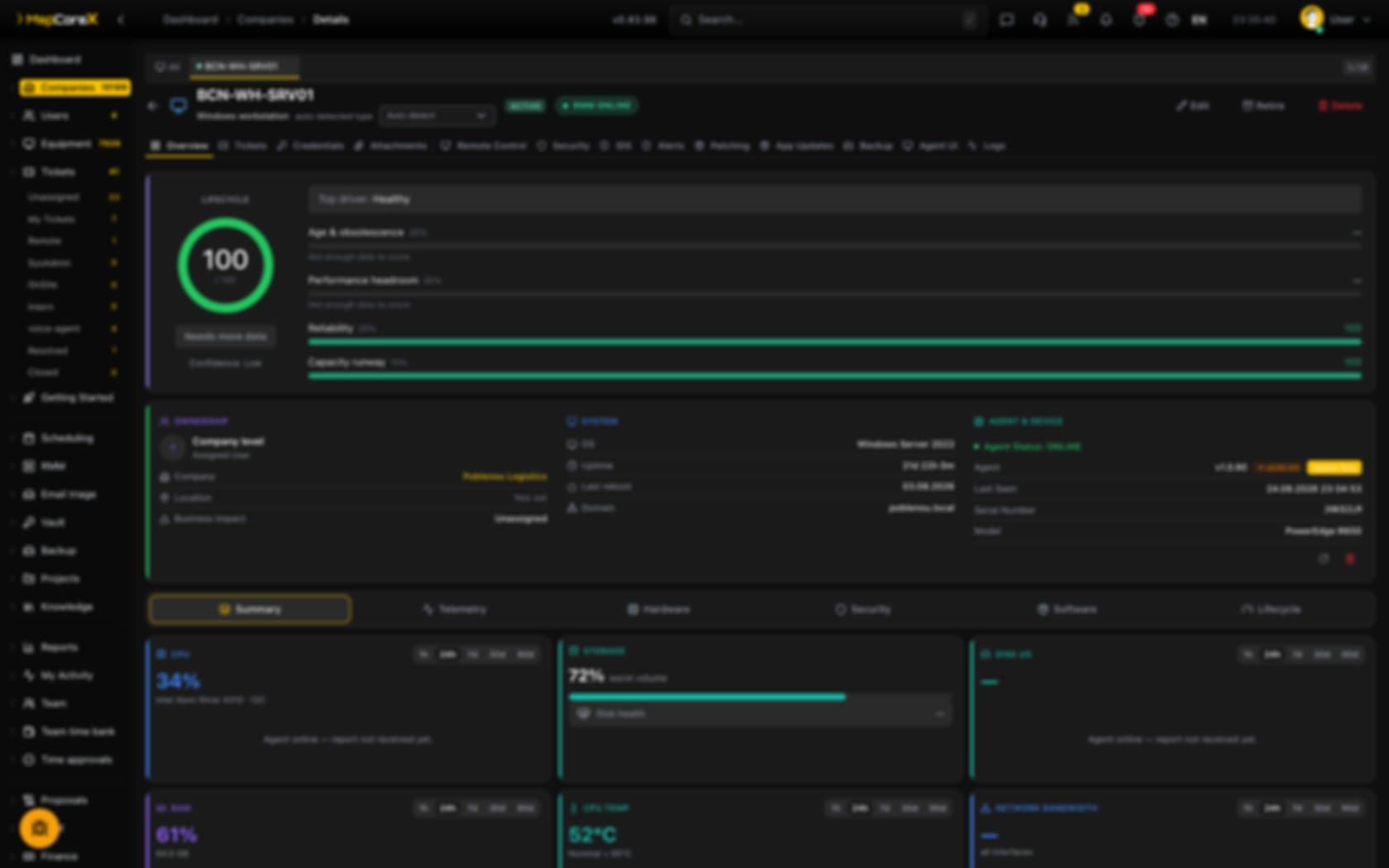
- →Health metrics (CPU, memory, disk, network) streamed to ClickHouse — query millions of events/sec.
- →Enrollment by one-time code — per-device keypair, no persistent secret on the endpoint.
- →NinjaOne importer for one-way org/device/location migration from the legacy RMM.
The actual product.
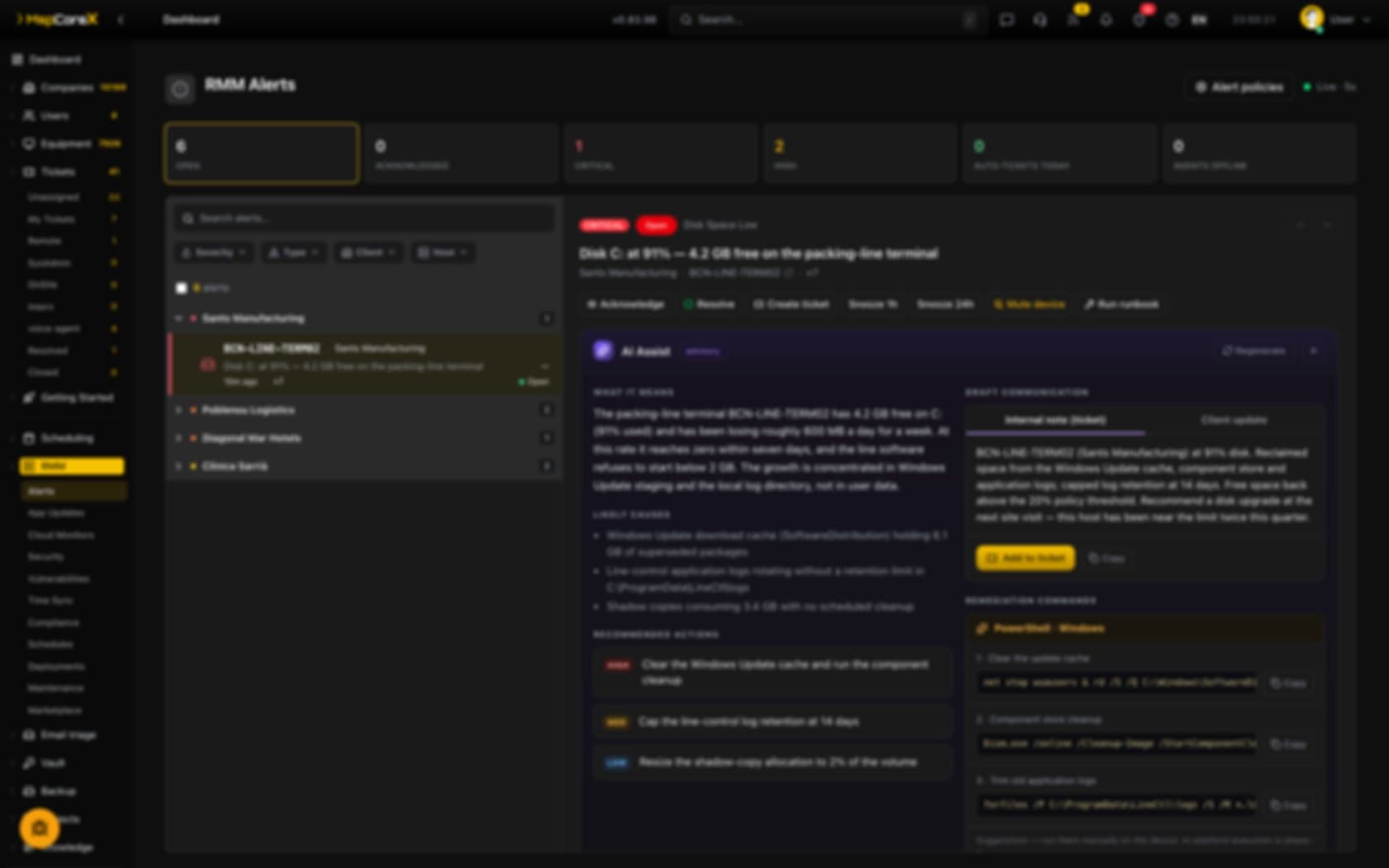
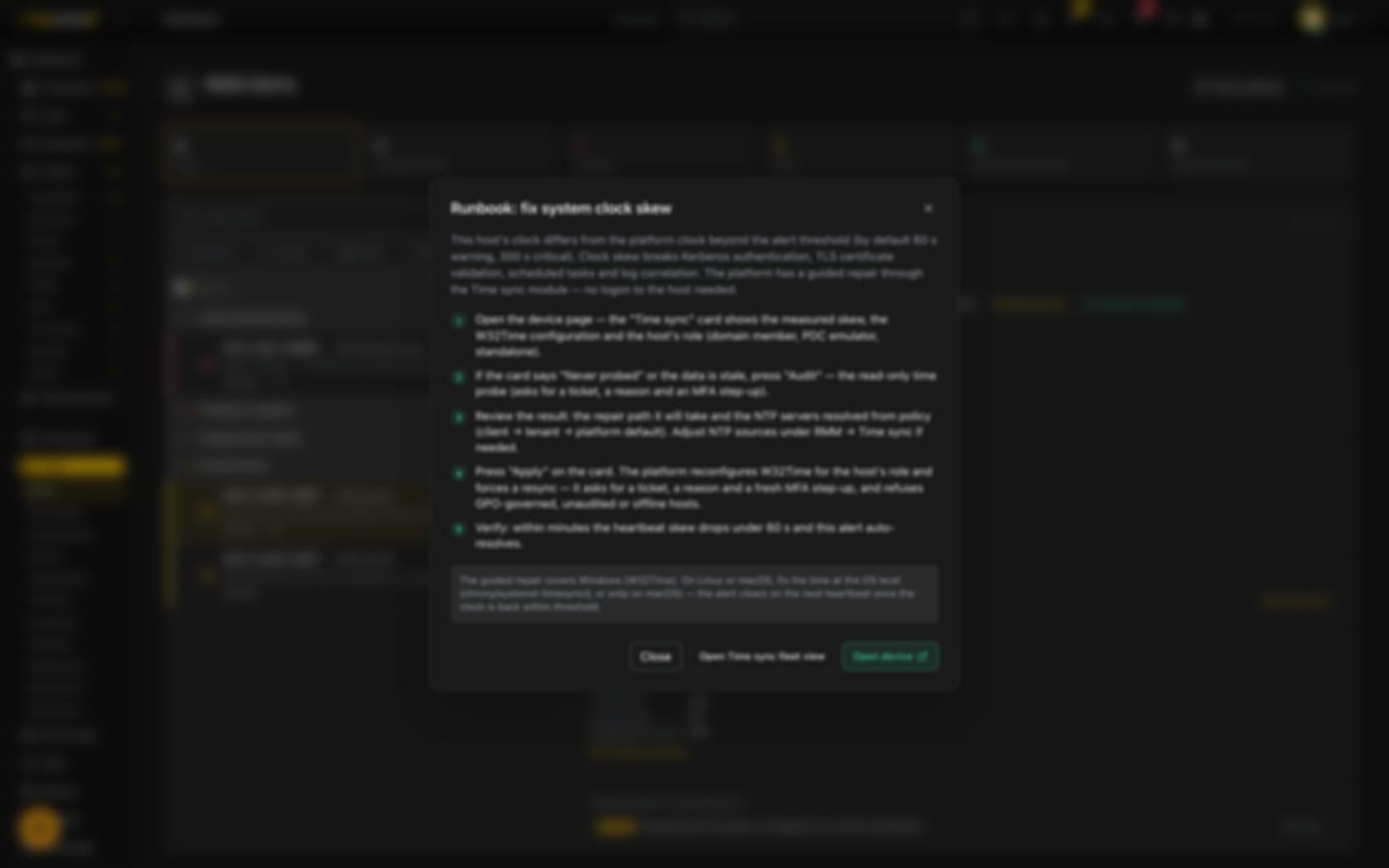
Screens from a running instance on demonstration data. Softened on purpose — customer records never appear on this site.
Core capabilities.
Zero-trust agent enrollment
One-time enrollment code → per-device ed25519 keypair generated on-endpoint. Server holds public key only. Revoke server-side, agent loses access instantly.
ClickHouse telemetry store
Every metric (CPU, RAM, disk I/O, net, process, service state) ingested to ClickHouse. Millisecond query over 12+ months of history. Per-tenant retention + sampling.
Predictive alerting
Anomaly detection on baselined signals. Auto-create ticket, page on-call, open remote session context — before the customer calls.
Software inventory
Full installed-apps list with versions. Cross-referenced against public CVE feed. Flag vulnerable installs per-client.
Process & service control
Start / stop / inspect processes and services. Restart machine. Every action audited with operator ID and time.
Health dashboards
Per-agent and per-fleet views. Online/offline presence, last check-in, resource trends, alert state.
Cross-platform
Windows 10/11 + Server 2019+, macOS Monterey+, Debian/Ubuntu 10+/20.04+. One orchestrator, one dashboard.
Auto-update pipeline
Signed release channel. Canary ring → stable ring. Rollback on telemetry regression.
Rust core on the endpoint (<50MB RAM idle, <2% CPU), TypeScript orchestrator server-side, ClickHouse 24.3 for time-series telemetry, MySQL 8 for control plane. WebSocket bidirectional with HTTPS long-poll fallback. Installer formats: NSIS (Windows), pkg + launchd (macOS), apt repository (Debian).
FAQ.
How does enrollment work without exposing a secret?+
Admin generates a one-time enrollment code. The agent uses it once to register and generate a local ed25519 keypair. Server stores only the public key. The enrollment code self-expires after use or 24h.
Resource footprint?+
Rust core: <50MB RAM and <2% CPU idle. Telemetry rate-limited (configurable per tenant). No third-party Electron or JVM on the endpoint.
How deep is the telemetry?+
CPU / memory / disk / network / per-process / per-service / event log (Windows) or journald (Linux) / system log (macOS). Sampled at 60s default. Configurable per-agent.
Can I run the agent on an air-gapped network?+
Yes — the agent can be configured to use a relay (self-hosted) and stores offline telemetry until it can send.
What about legacy RMM data?+
NinjaOne importer is built-in. Brings organizations, devices, locations in one pass. More importers (Atera, Datto RMM) are on the roadmap.
Related modules.
Patching
Campaigns. Stage rings. Rollback. Per-client compliance reports.
Backup & Recovery
File, folder, image. Ransomware guard. Instant restore from clean snapshot.
Remote Desktop
WebRTC-native. Multi-monitor. Session recording. E2E. No third-party relay.
Network Discovery
Map what is on the network. Find what the agent is not on.
Scripts Marketplace
Signed scripts. Approval workflow. Scheduled. Audited with output.